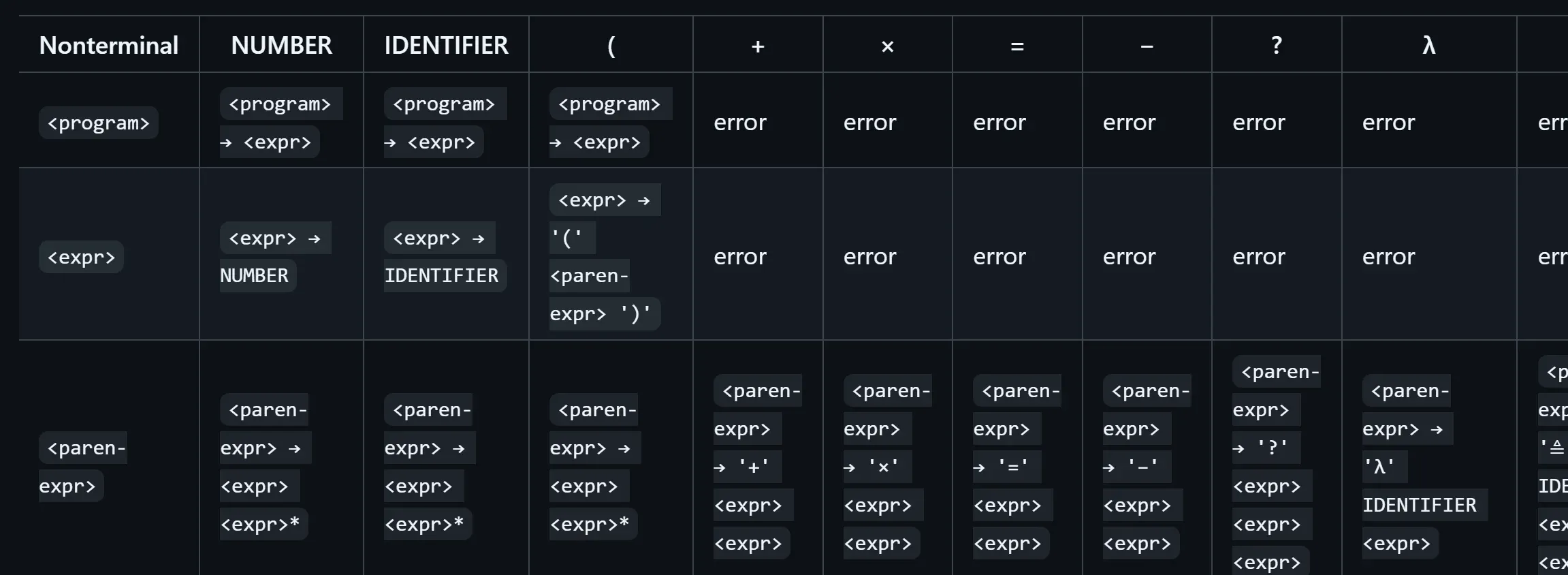
For one of my university projects in Theory of Computing Science (41080), my group and I built a small but fully functional MiniLisp interpreter using an LL(1) parsing approach. It started outlooking very theoretical with parse tables, grammar rules, notation, and so on. But, by the end I had a working interpreter that could actually read and process MiniLisp code.
Understanding the Goal
The challenge was to design and implement the three core stages of a compiler front end.
Grammar and Parse Table
Define language rules and FIRST/FOLLOW sets.
Lexer
Convert raw text into structured tokens
Parser
Apply the LL(1) algorithm to validate and interpret the input
Each team member took one component. I handled the lexer, which reads plaint text and turns it into a sequence of tokens (the foundation of any parser or interpreter)
Designing the Lexer
My lexer was written in Python and built around a generator function called lex(). It yields Token objects containing a type, lexeme, and precise position in the source file (line and column). The spec required full Unicode support, so it needed to recognise operators like - (minus), × (times), and λ (lamba) in addition to standard ASCII.
That detail was trickier than expected - not just due to regex patterns, but because different editors sometimes substitute ASCII hyphen - for the Unicode minus −. I fixed this by validating exact code points and adding tests to catch the mix-ups.
All tests were written with pytest, covering single tokens, identifiers, numbers, and illegal characters. After that passed, I added line/column tracking so syntax errors point to the right place. This was a small change, but it made debugging much easier later.
Working as a team
We managed everything on GitHub with feature branches (feat/lexer, feat/parser, feat/analysis, …). Pull requests handled review and integration. It was my first time properly using a branching workflow in a group, and it kept things organised and predictable.
By the end, everything connected cleanly: the lexer’s tokens matched the grammar’s terminals, and the parser processed full MiniLisp expressions without crashing. Watching the system read something like (λ x (+ x 1)) and actually tokenise and parse it correctly was very satisfying.
What I learned
- How LL(1) parsing tables really drive syntax validation in practice
- Why token consistency between lexer and grammar matters so much
- Designing modules for collaboration (clear APIs and contracts)
- Debugging boundary issues between components (as opposed to just inside them)
Tech stack
| Language | Testing | Version Control | Core Modules | Concepts |
|---|---|---|---|---|
| Python 3 | Pytest | GitHub (feature-branch workflow) | src/lexer.py, src/tokens.py, src/parser.py, tests/test_lexer.py |
LL(1) parsing, Unicode tokenisation, regex matching, error tracking |
Reflection
What I enjoyed most was the mix of structure and creativity. LL(1) rules are strict, but the implementation isn’t. I like that I was able to combine formal grammar logic with hands-on coding. It gave me a solid foundation for understanding compilers - something I’ll use in future subjects and projects.